Honestly, this feels more like a retrospective. My original plan was to frame this as a normal review, playfully claiming it was just another local band I was looking into. However, in the interests of remaining honest in my work, I decided against that. Equally, I am not worried about stating prior personal interests, because I can be fairly critical of myself (which you will see going forward).
Let me give you some backstory to this. The Monarch Phenomenon is/was the latest in a series of bands populated by myself and my close friend Rhys. Prior installments of similar projects had involved other people, but we eventually decided to not rely on anyone else. We just wanted make music for ourselves. This iteration of our band was created when we were nearing the end of secondary school, and we persisted together working on music through our A-levels and into university. It was just the two of us doing everything at this point…though in honesty, Rhys did most of the heavy lifting. He was a guitarist first and foremost, but also did bass, programmed drums (+ other instruments) and growled vocals, as well as near professional music mixing when he reached the peak of his power. I, meanwhile, was the clean vocalist, provided samples, wrote lyrics and came up with the “concepts” for each song and album. I was honestly probably insufferable, but I’m thankful for Rhys’s patience with me for the most part (even if I wish he’d trusted me on a few things and/or let me indulge in weird ideas more often!)
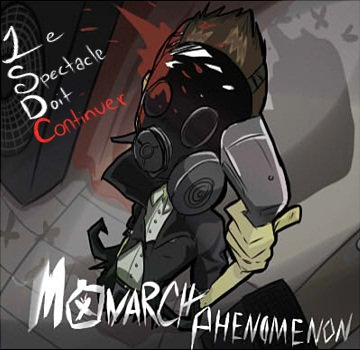
Why “The Monarch Phenomenon”? I heard the phrase used by David Attenborough to describe the bizarre migration of Monarch Butterflies, and the name just kinda stuck. The title of our first album under this name was also appropriate, since we’d worked with other bands that never went anywhere, and decided to keep going ourselves. Thus, the show must go on. The album artwork was provided by a friend I met online, though my original request was a little more detailed. It was meant to be a man wearing a gas mask, standing on a theatre stage under a spotlight, pointing his finger like a gun to the side of his head. Behind him were shadows of butterflies flying out the other side of his head, which would have made the imagery much more subtle that what we ended up getting. Still, what I did get was good enough in my opinion. And yes, this kinda thought about album art is why I often comment on artwork in my reviews.
Before I go over every track, I should mention that this album was recorded and edited entirely using a primitive home-recording setup, and was sitting around on our drive for a few years before it was uploaded onto bandcamp. I’d say it was finished around the time me and Rhys were in the middle of our A-levels, but it didn’t see the light of day until we were both at Uni.
So to begin, Rise Up from the New Cold (and its extended intro, Prelude) was the first song that me and Rhys wrote as The Monarch Phenomenon. Rumblings of it existed with our previous band (the unfortunately titled “Patriarch”), but it didn’t reach its current state until we were on our own. Earlier bands we’d been involved with had been much less “heavy”, and could probably be described as general rock or punk bands. After years of holding back, we wanted to make a really heavy, dramatic track to cement our move to metal, and thus this song was conceived. Even the title and lyrics implies a kind of dark rebirth!
The spooky voices after the first chorus were sampled from Silent Hill: Shattered Memories, which also inspired the tone of the song, along with having some other subtly hinted references sprinkled in the lyrics too. That said, this wasn’t a song about Silent Hill. It was a song about generally trying to put the past behind you, only to have those same insurmountable memories come back with a vengeance to smother you. Of course, being critical, there were aspects of the song I wish we could have done better. The evil laugh I did on the bridge before the solo never sounded quite right, and my falsetto vocals near the end of the song still make me cringe whenever I hear them. These were hilariously mislabeled as “female backing vocals” on review of questionable quality the album was given from a website I now struggle to find. I don’t mind people not liking my stuff, but at least get our criticisms right!
Speaking of which, I normally find the idea of writing a song as a tribute to someone to be a little bit “cringe”, as the young people say. However, I am someone who embraces my inner cringe from time to time. Thus, Kantian Ethics was a song written during my A-Levels in Religious Studies that became a tribute to my teacher at the time. This gentleman, an atheist teaching at a catholic school, was truly inspirational and was more of a philosopher than merely an informer of religious practices. Sadly, in true Autistic fashion, I can now no longer remember his name; a fact that brings me great sadness.
This song now exists as a legacy of the impact he left on me. It’s one of the older songs on the album, persisting from the previous band’s iteration, and the lyrics were originally jokingly written to act as revision reminders for one of my assessments. From a purely personal perspective, I actually quite appreciated the teachings of Immanuel Kant, especially the idea of doing the right thing because it is inherently the right thing to do, not because you want to be rewarded for it. I also enjoyed his desire to cut out needless complexity from moral systems as well, though I think this can be taken to an extreme if misused (both of these concepts being topics that show up a lot in this album). As for the song itself, the use of funny time signatures was actually added into the song after it was initially written.
On the topic of unnecessary complexity, that is the theme of Barrier Obscure. However, rather than moral barriers, these ones were more internal. As someone with Autism, I have always struggled with masking, as well as understanding the subtle nuances of social interaction. This song basically embodied my desire to break out from within and let my true eccentric self flow, while being held back by years of anxiety and social norms that had repressed such things. There are certainly some bum notes on my vocals here, which are grating to hear listening back, but this kinda thing was hard for me to sing about (if you could consider that an excuse). That said, I am happy with the various harmonies in this song, as well as many of the others. I was originally terrible at that sort of thing, but thanks to Rhys’s constant pushing for me to try it, it now comes second nature in my modern vocal work. And on a final note before moving on, the synths and vocoded acapella section on this song have become some of my favourite parts of this album, even if their implications lyrically are quite tragic!
The next two songs, “Wars Against Common Sense” and “Alertness Deadzone”, are both extensions of the previous in terms of themes. The title of Wars was actually inspired by something written in a book by Jeremy Clarkson (something hinted to in the lyrics.) It’s a concept that has aged like fine wine in modern times, even if the inspiration aged more like a dead animal under the floorboards. A hilarious memory I have of making this track is that I ended up putting vocals in completely the wrong place for this song. Rhys had intended that I would come straight in with singing, but I ended up putting my vocals for the verses in what he had considered a bridge to the chorus. This would eventually become a running theme for our musical adventures, as I would often end up doing similar things many times in the future. These creative clashes of ideas became core to the music we ended up making, and it’s actually something I look back fondly on. Rhys was often exasperated by it, but even he would sometimes come around to liking the results.
Lyrically, while Wars was more about trying to bring people together (which actually has ominous implications considering the end of Barrier Obscure) Alertness Deadzone was inspired by my biology studies. Specifically, it was inspired by the realisation of how flawed the human mind actually is (a theme much more explored in the second album), and how fickle and frail certain parts of the human body can be in turn (with some of these frailties even outlined in the lyrics). It was basically a criticism of people who see humanity as a perfect creation. And speaking of criticism, I must confess that I feel Alertness Deadzone’s verses are much better than the chorus, which feels like something of a letdown after all the buildup to get to them. My first criticism of Rhys’s work also exists in these songs, as I felt that some of the drumming on these tracks feels a little bit out of place/overwhelming. He was listening to heavier music than I was when we were recording the album, which probably contributed to this. Over time I came to feel less strongly about it, not to mention that I certainly bumbled some of the vocals on these tracks too…so maybe I should keep my mouth shut. Ironically, the mistake I made on the final chorus of Wars (lining up the two takes of “some of us are broken”) ended up being intentionally left in since we both thought it sounded cool and was lyrically fitting…so maybe I should keep yapping? Well, I’m going to, because I still have more to say! “Typical man!” I can hear some people complaining.
And that segues perfectly into song seven, “The Patriarch Dies”. I previously mentioned that Patriarch was the name of one of this band’s previous incarnations. In truth, that band was named long before the awkwardnesses of modern vernacular and social tropes from certain groups had spread so far. We actually named that version of the band after a boss fight from the video game Killing Floor, something which is equally bitter considering how that franchise ended up castrating itself. As another amusing anecdote this song is the shortest on the album (not including the Intro). This was done mostly out of playful spite for my father (a punk at heart), who complained that we wrote too many long songs. He challenged us to write one that was less than three minutes in length, and I’m pretty pleased with the result.
The song talks about how the eventual absence of previous guiding figures can be both liberating but also daunting. It’s also a jab at the previous state of the band, which had grown stale and stagnant until me and Rhys went away together to do our own thing. Sadly, on a more personal note, it’s also actually come to fruition. When I first wrote this song, all my grandfathers were still alive, and existing without them was merely a future hypothetical. Now, they are all gone, and this song feels a little tragic in hindsight. Here’s to hoping they really did fall into the sky.
Toys of a Failed Era is probably my least favourite track, and unfortunately highlights a small issue this first album had. While some songs like Rise Up, Kantian Ethics and Patriarch Dies were very distinct, unique and creative, I feel that others are more like “filler.” They end up bleeding together, sounding too similar, having less interesting things to say or covering the same ground as previous tracks. This song, along with Wars and Alertness Deadzone, are probably the worst offenders of this. Even the message of Toys of a Failed Era is similar to previous tracks, as it speaks about the difficulties of trying to be more mature and “put away childish things”, which is similar to the themes of Rise Up and Patriarch Dies, just put more bluntly. That said, the solo with echoed vocals (yet another example of me putting words in the wrong place that ended up working) is probably the best part of the song, and elevates the whole piece.
Curiously, the most popular song on the album (according to other reviews and feedback from other bands) was usually The Angel Angle. This is ironic, as I would consider it another “filler song” outside of the epic intro. The entire concept of the song started as a pun regarding how people sometimes mix up the spelling of these two words. Within the lyrics, it covers a theme that could be the basis of a scifi story (ironic considering a later song), asking the question “what would happen if science truly did find some unifying theory of everything?” The ironic conclusion that the song comes to is that we would still frustratingly invent or create some artificial way to limit and stifle ourselves, because we, as a species, seem really good at that. Again, this is a theme touched on in other ways earlier in the album, but people really seemed to like this one, so I guess I should give it the credit it is due.
I think it’s appropriate that the energy of the album picks back up with Perception Scale, which is by far the oldest song on the album. In fact, it’s something of a progenitor for not just this album, but the entire band as a whole. This track was in production when Patriarch was still called Brought By Order, and we were still in the middle of Secondary School. It was made using the polar opposite in principle to The Patriatch Dies. Instead of making a really short, punchy song, we wanted to make a really long, epic song. We just kept adding and adding to it, and it grew from being around 4 minutes when initially composed to its current 6 minute length. Hilariously, over time, we ended up making even longer and even more epic/pretentious songs, but even so Perception Scale basically marked the beginning of me and Rhys finally finding our “sound” in music. It’s also one of the best mixed songs on the album in my opinion. As for what the lyrics mean? Honestly, it was just a streaming flow of consciousness, probably inspired by the lyrics to Scar Symmetry tracks. Either that, or I just don’t remember.
The next two songs stand as polar opposites in a completely different way. While Empty Flag resonates with uncomfortable right wing rhetoric delivered in a highly tongue-in-cheek manner, Collective Glow seems to propose a much more optimistic (and left wing) sounding alternative. However, the theme of shedding individuality and unifying has been covered quite extensively in the album by this point, which more subtly hints to the possible costs of such a path, even if the song itself doesn’t sound so negative. The final line of the song, however, really hammers home the possible futility of such a path, not to mention the not-so-subtle cult-like undertones of the track. Both these songs were born from a time when I was still trying to figure out my own political leanings, and functioned as something of a criticism of extremism in both directions.
Now…if you asked me “what is the best song you have ever written”, I’m pretty certain that the answer is, and always will be, Replicate Man. The previous three tracks were inspired by other bands, like Scar Symmetry, Rush and Solution 45. Replicate Man, on the other hand, was inspired by a mix of Batman, Fallout 3 and the band The Interbeing. It functions as something of a “Concept Single” for a creative writing story I never quite got around to making in a more traditional form until much later. This song tells of a hypothetical future where human cloning is not simply allowed, but mass produced, resulting in “Replicates” who are used as indentured servants by others, as well as creating a vast enslaved work force for humanity to benefit from.
Before you claim that I ripped off Blade Runner, do remember that I was probably about 14 when I wrote this. I genuinely had no idea about that film at the time, and there’s one key difference in my story that can prove this: only one person was ever actually cloned in Replicate Man. This single person “sold” his genetic sequence to create all these replicate people, amassing an absolute fortune in the process. This song, however, takes place in the titular Replicate Man’s twilight years, where he has become horrified at the world he helped to create, and terrified about the state of his immortal soul. He fears that it has been splintered across countless tortured copies of himself, never to know peace.
I normally don’t like glazing myself, but even looking back over a decade later, I’m proud of myself for coming up with such a heartbreaking (and fucked up) concept, as well as this track having some of my best vocals and harmonies on it too. And in case you are wondering why Batman was listed as an inspiration, here’s the story of that (I’ll leave you to figure out the other inspirations for yourself!) In one of the episodes of the animated series, Batman fought a villain who could clone himself, but each subsequent copy became more and more twisted and violent, leading to him saying something along the lines of “Like a photocopier, each replicate is darker than the previous one.” This idea stuck with me, and became part of the thematic basis of this track. However, shockingly, this is not the darkest song on the album.
The penultimate track, ominously titled “Complete Global Euthinasia”, is another much older song alongside Kantian Ethics and Perception Scale (though the extended intro was added much later). It was formulated when I was going through a particularly depressed and nihilistic period in my youth. I’d probably just come to terms with the futility of trying to do good in a world controlled by such widespread corruption, and hadn’t reached the bloody mindedness of just doing good anyway. As such, I started to envision a terrifying solution to the problem of humanity and its “inherent bad influence”. That solution, one that countless villains had already come to, was to scorch the entire surface of all human life. I probably wasn’t acting depressed and edgy on the surface as I wrote those lyrics, but I do remember my parents being horrified when they heard this track for the first time.
Regarding the song itself, there’s actually a huge mistake regarding the progression of the synths that persists even to this day. Their transitions weren’t aligned correctly in the mix, leading to them cutting out at the wrong time. Another amusing anecdote is that during a previous demo recording of this track, the guitars had been mixed in a very janky way which resulted in a strange echoing frequency through the track. This frequency, to my ears, sounded like a keyboard or a synth in the background. Thus, the synths and keys on this track were not there originally, and were added later after I commented that the song felt empty without that tone in the background. Rhys was hesitant to do this, but I think the effect works well even as I listen back now, and I hope you agree.
Lastly, would you believe me if I told you that the finale of this pretentious-ass heavy metal album, put together by some relatively clueless teenagers, was inspired by the song Suspect Device from Stiff Little Fingers? You probably wouldn’t, but it’s completely true. I really enjoyed how that song started out as a violent criticism of regimes the band did not agree with, but near the end of the song the vocals turn a full 180 and change from “Don’t believe them” to “Don’t believe us”, highlighting how good intentions can become just as bad as the things they criticize (or simply admitting that no one has all the answers, and anyone who says they do should not be trusted.) This entire concept set off fireworks in my brain, and “Final Curtain Call” became my own version of this idea. After all the talk about personal struggles, societal difficulties, political conflicts and dark futures, I imagined myself as a performer on stage at the end of a theatre production proclaiming to the crowd one final subversion. This song was, in effect, the “moral of the story.” I also wanted this song to be a hypothetical “show closer”; one we would always play to finish a live set, as a way to say thank you to any fans we might have…in a playfully misleading way.
Honestly, I’m proud of how it turned out. Not just this final song, but the whole album. There are a few tracks in the middle that are kinda superfluous, and obviously the mixing is quite primitive by the standards of other bands in modern times, but considering this was just me and my best friend, I think we did a pretty decent job of putting together some good music. It also paved the way for the album’s much superior sequel, which I will cover another time.
Ironically, the closing lines of Final Curtain Call claim that I hope we were not being listened to. Well, that turned out to be the case. The Monarch Phenomenon never became famous in the end. Still, I suppose I shouldn’t be too upset that I got what I asked for. I just wish that the world was in a better place for it.
If you’re into weird, schizophrenic and kinda pretentious metal of various genres, drawn from wide inspirations, then I’d recommend giving this album a listen, especially for the excellent lyrics and guitar work! And I don’t just say that because it’s my music…thought it doesn’t hurt either!
← Back to Reviews